How could an experiment about a worm and legos be the most underreported and profound event of our lifetimes? Consider this: researchers found a way to copy a worm’s brain into a Raspberry Pi microcontroller, and connect it to a Lego robot. When they turned it on, it began to behave like a worm. As unbelievable as this sounds, this was a real experiment, done by the OpenWorm Project in the year 2014. If you consider the implications, then you might ask whether the robot had achieved some level of consciousness - or whether life forms such as the worm are simply squishy robots.
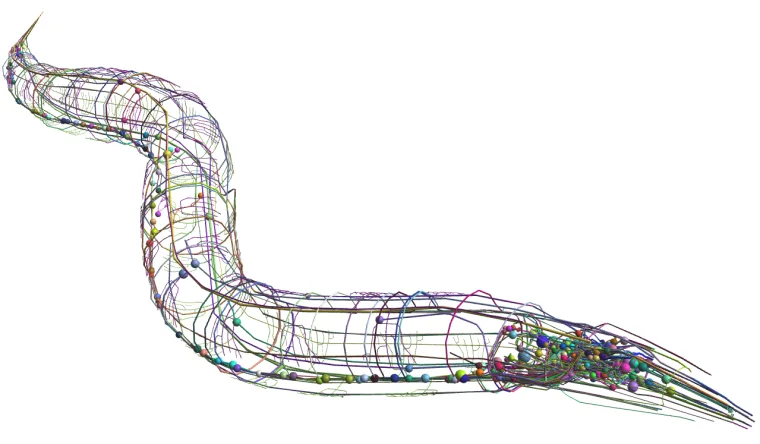
OpenWorm researchers first had to begin replicating the brain of the C. elegans. They achieved this by mapping each individual neuron of the worm’s brain using an electron microscope, and then studying how each of the three hundred neurons and their seven thousand synapses were connected. Using tools like graph theory and connectome mapping, which charted how all these synapses transmit signals and communicate with each other, the researchers were able to model the network structure in software. This was combined with simulation software in order to recreate the neurons’ electrical dynamics. The completed copy of the neural network allowed the researchers to create a virtual C. elegans, which could be placed into a working lego robot to see it firsthand. The important thing to understand here is that the researchers did not intentionally program the robot to do anything specific. Its behavior was a result of it operating independently. The wheels served as the muscles on the sides of the worm’s body, and a sensor was placed on the front of the robot to represent sensory nerves. The robot’s movements were purposeful, acting as the worm normally would in its natural environment. The wheels moved in a wiggling motion, mimicking real movements.
The OpenWorm project marks the beginning of a new field of science called artificial life. This “silicon based” organism serves as a model that will allow scientists to understand, and eventually copy, more complex nervous systems - meaning larger brains. With recent advancements in robotics, such as Boston Dynamics’ Atlas and Tesla’s Optimus, and such accomplishments in artificial intelligence like OpenAI’s ChatGPT and Google’s Gemini, we can expect these technologies to merge. Would we give them rights, just like humans? Would they be considered conscious? Imagine a world where robots walk among us, commonplace in our everyday lives.